Solar Manufacturing USA: the module quality protocol behind a decade of tax equity
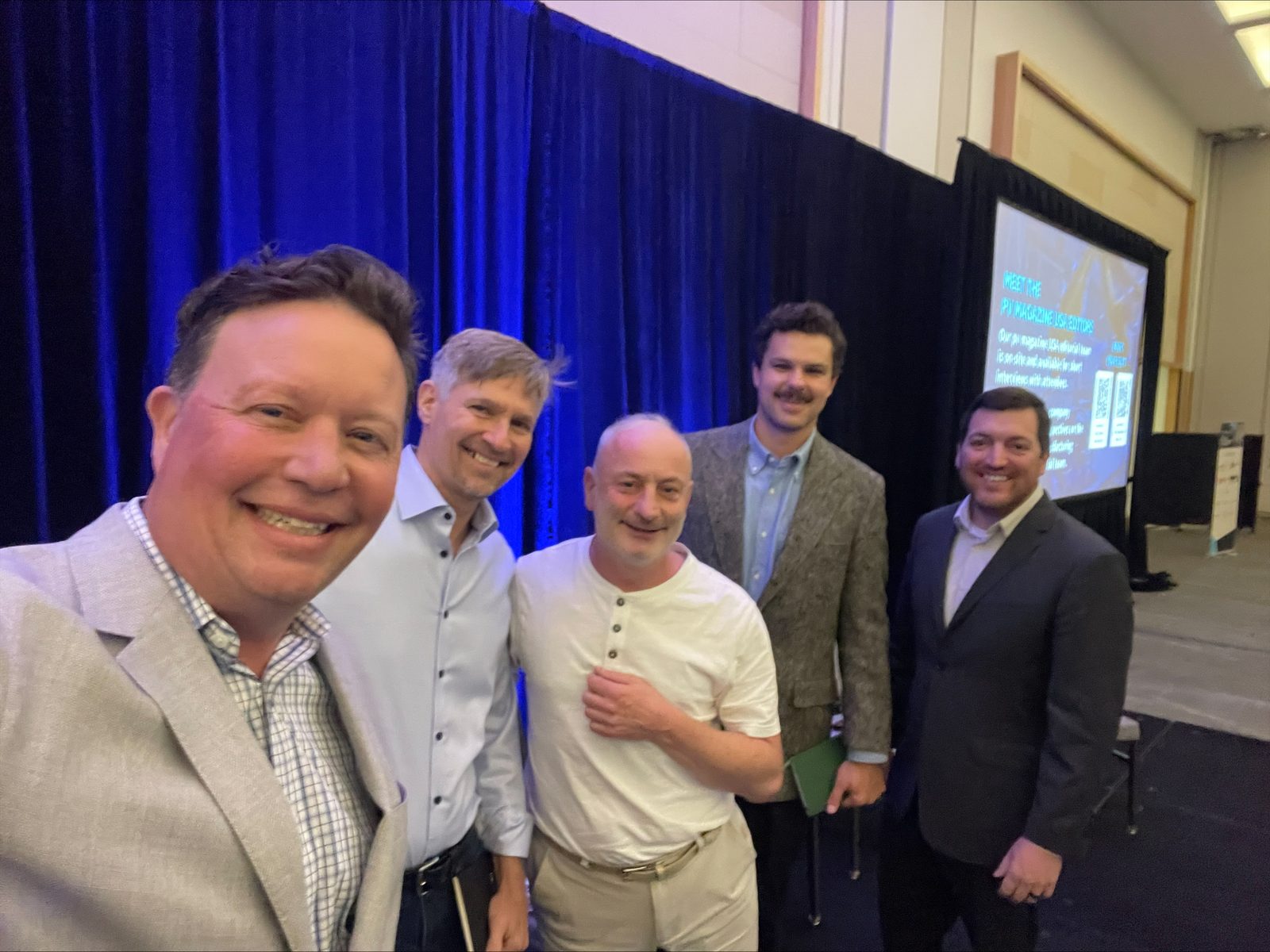
At the first pv magazine USA Solar Manufacturing USA conference in Austin, I walked through the PV module quality assurance program I built and ran for nearly a decade in the solar tax equity group at Wells Fargo. Extended reliability testing, factory audits, batch testing — and what to do when the results come back bad or late.
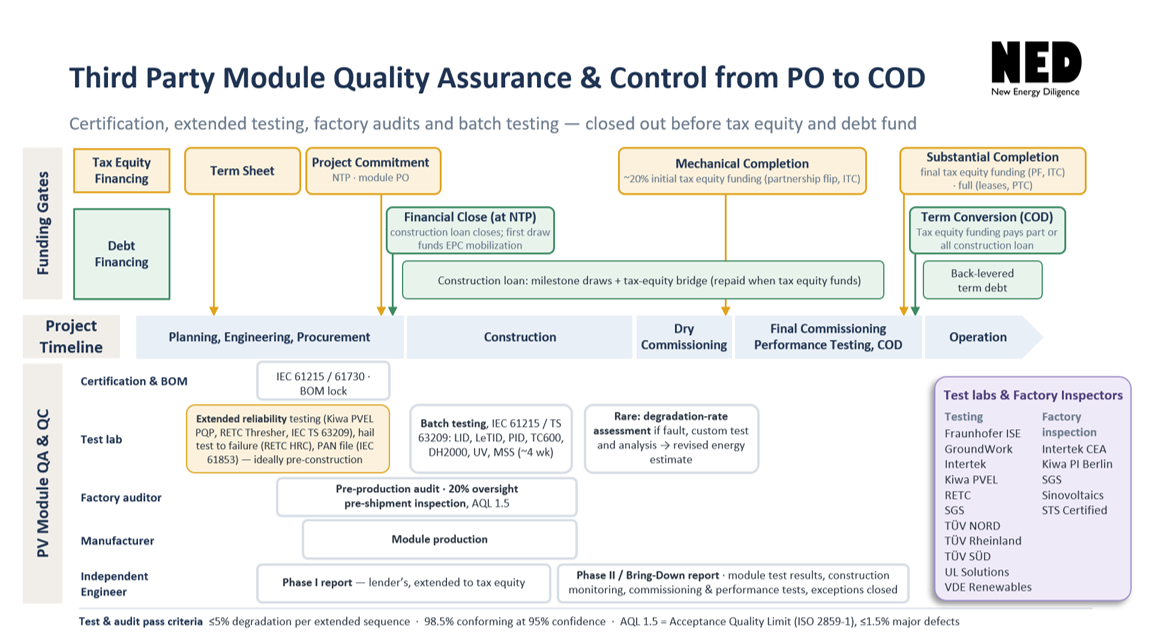
Wells still uses the protocol. Ideally it starts six to eight months before module production, with extended reliability testing of the bill or bills of materials (BOM) for a project. Tests can be Thresher from RETC, part of the VDE Group, PQP from Kiwa PVEL, IEC TS 63209, or equivalent. They are roughly three times the dose of heat, cold or humidity, plus static and dynamic load and a hail test to failure for hail-prone areas — RETC’s Hail Resiliency Curve test, which I helped create, is one way to do it.
Third-party module QA & QC from PO to COD, mapped against the funding gates it has to clear: certification and BOM lock, extended reliability testing, pre-production audit and production oversight, batch testing, and the IE’s Phase I and Phase II reports. Open full size ↗
Factory audits follow, a discipline Ian Gregory and Peter Rusch of SolarBuyer, now Kiwa PI Berlin, taught me. A pre-production audit sends an inspector fluent in the local language to check processes, equipment, component storage and the rest, and to fix issues before the project’s run. It takes a day or two, and OEMs usually welcome it. Production oversight then covers the run with random visits one day a week, more on a troubled line.
The auditor also pulls about twenty-five modules per BOM and workshop combination for batch testing to IEC 61215. Wells now requires some longer tests. Batch testing only predicts about five years, but it catches what audits cannot see. Ongoing pre-shipment audits confirm the modules are sent to the project and review manufacturing execution data — electroluminescence images, QA and QC test results — to hold major defects below 1.5% (AQL 1.5). That is loose for an iPhone, but it is market for high-volume, low-cost solar, and it has not seemed to cause material underperformance.
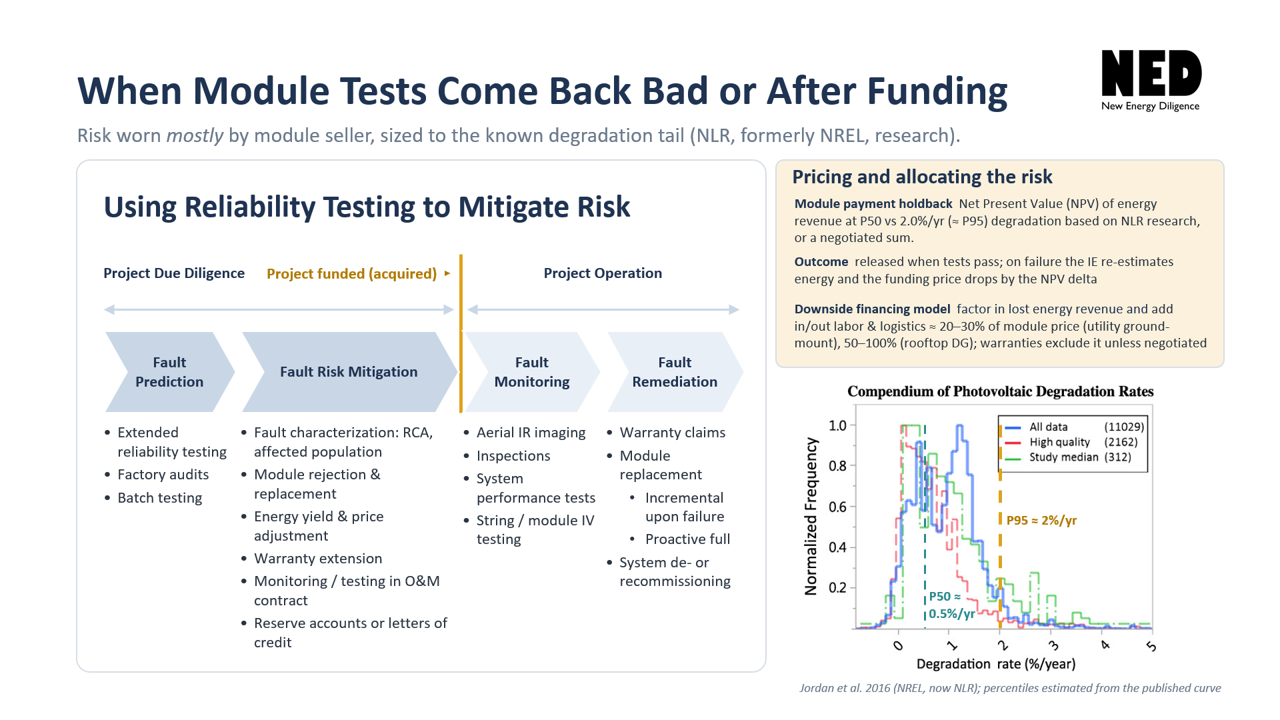
If test or audit results come back bad or late, I recommend financiers and buyers hold back a portion of payment, sized to the revenue potential (NPV) of the affected modules assuming a downside yearly degradation of 2%. Two percent is around the 95th percentile of the National Laboratory of the Rockies degradation compendium (Jordan et al. 2016). If late tests or audits come back clean, release the funds. If not, work with the IE and the test lab or auditor on materiality and risk mitigation — root cause analysis, retesting, repair, replacement, extended warranty, aerial IR monitoring. A harder route is estimating degradation over a typical 0.5–0.75% per year via custom tests, using methods from Michael Kempe and Dirk Jordan (2017).
Predict, mitigate, monitor, remediate — and how the holdback is sized. P50 degradation sits near 0.5%/yr and P95 near 2%/yr in the published compendium, which is where the 2% downside assumption comes from. Open full size ↗
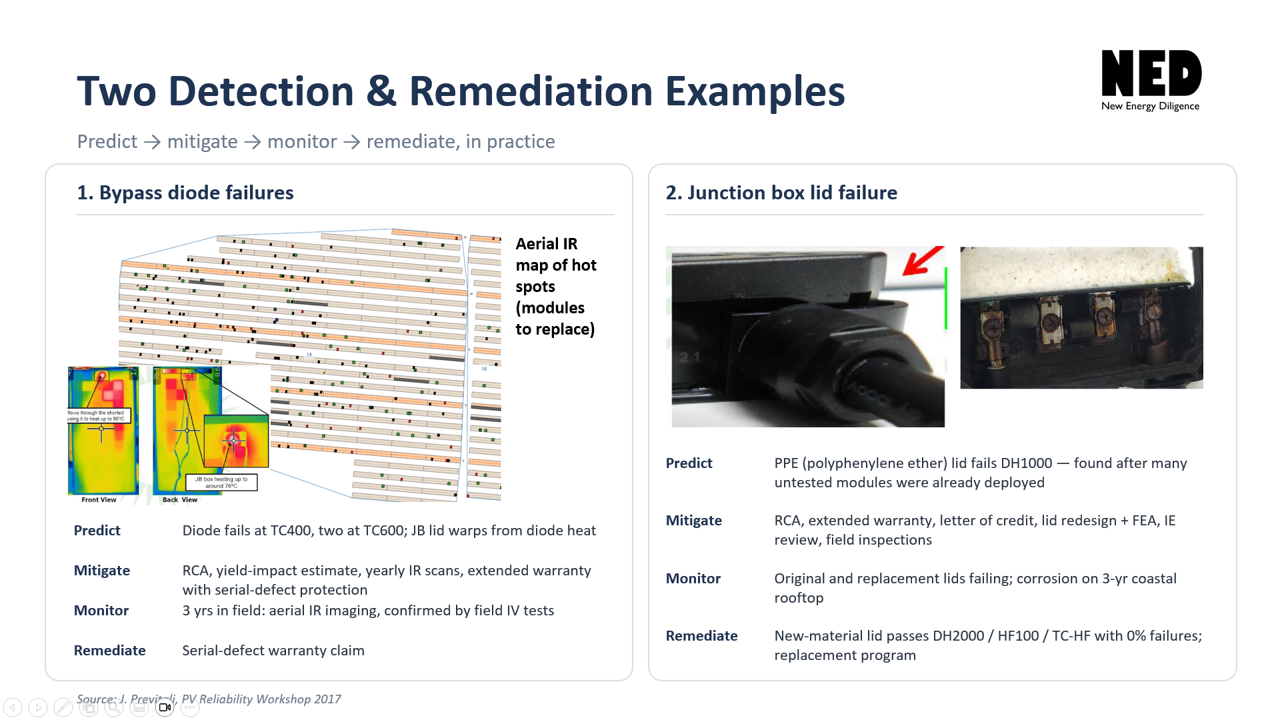
Two examples of how this plays out in the field. In the first, a bypass diode failed at TC400 and two more at TC600, and the junction box lid warped from diode heat; the response was root cause analysis, a yield-impact estimate, yearly IR scans, and an extended warranty with serial-defect protection, confirmed three years later by aerial IR imaging and field IV tests, and settled as a serial-defect warranty claim. In the second, a polyphenylene ether junction box lid failed DH1000 — discovered after many untested modules were already deployed — and took a letter of credit, a lid redesign with finite element analysis, IE review and field inspections before a new-material lid passed DH2000, HF100 and TC-HF with zero failures.
Two detection and remediation examples, from a talk I gave at the PV Reliability Workshop in 2017. Open full size ↗
And remember to put the required tests, audits and remedies in the term sheets, supply agreements and funding documents. The protocol only works if the contracts carry it.
What the war on solar misses: chips and solar share the same silicon
Chips and AI are tied to solar — at the silicon (a shared poly base) and at the socket (the fastest power for AI’s load growth). If we want domestic chips — security, jobs, AI dominance — we should support solar demand.
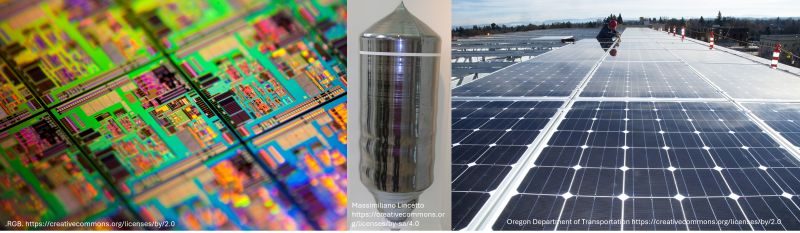
One silicon chain, three destinations: patterned wafer, polysilicon ingot, and installed PV. Image credits as marked.
Imported solar modules are about to cost ~$0.10/W more (ROTH Capital Partners). US modules now run ~$0.27/W wholesale (Anza Renewables); tariff-free Australia averages ~US$0.18/W (IndexBox). That’s the market Trump’s Aug 6 Section 232 proclamation hits Dec 4.
232’s stated intent is to force US prices up ~4x, so domestic producers of poly and Si wafers, cells, modules, can survive. Poly fell from $39/kg in 2022 to under $4.50 in 2024, taking every non-Chinese maker’s margin with it.
My “Ah ha!/Duh…” moment: the proclamation leads with semiconductors, not solar, but there’s an interdependency. Chips need chip-grade poly; chip-grade needs solar-grade volume; solar-grade needs solar demand.
Solar-grade and chip-grade poly share plants, know-how, and fixed costs. Chip-grade is a refinement step up, ~30x costlier. Solar is ~97.6% of global poly demand; chips ~2.4%. As an example, Germany’s Wacker makes both grades in the same plants. When buyers fled to below-cost Chinese poly, solar-grade demand evaporated — sales fell 41% (2024) — and though chip-grade grew double digits, lost volume gutted utilization: 2025 brought an €805M loss and restructuring. Chips bring margin; solar, volume; plants need both.
It happened here before — the killer was lost demand, not cost. China’s 2014 tariffs cut US poly off from China, where nearly all solar wafers are made (the US hadn’t built that step). US poly revenue collapsed ~$1B to ~$107M. Half the world’s production in 2005 to under 2% in 2024. The casualties were both chips and solar: Hemlock (both grades) abandoned a $1B plant. REC Silicon (solar poly + chip silane gas) mothballed $1.7B and exited — solar losses, REC said, starved its semi business. Solaicx — my friends Peter Bostock’s and John Sedgwick’s mono-ingot start-up was lost in SunEdison’s 2016 bankruptcy; GCL-Poly bought the IP, scaling it to 20GW in China. Chip fabs ran the same arc — US share fell 37% (1990) to ~10%, chasing Asian subsidies Washington wouldn’t match. So, taxpayers are now buying both layers back through the $52B+ CHIPS Act, e.g., $325M to Hemlock, the only US-owned chip-grade maker of five worldwide. A poly price floor without solar demand ignores both lessons: cost fixes fail if you kill demand — and the demand is solar.
And what an elegant harmony the solar and chips synergy fosters: AI data centers drive steep load growth; solar serves it fastest and cleanest. Same silicon in chips and PV modules.
The takeaway: if we want domestic chips, we need to support solar demand — the foundation under the silicon chain. Protecting poly but waging war against its biggest user, solar, is an odd way to prop up an industry.
The FCC’s inverter Covered List: why “audit your dongles” is now real advice
I never thought “audit your dongles” would be serious regulatory advice. Yet here we are: the Wi-Fi stick on your solar inverter might freeze it out of the US market.
Marconi at his wireless apparatus. A radio on the board is now a regulatory fact, whether or not anyone uses it.
Domestic factories supply only about 7% of the US solar inverter market. On July 28, the FCC added foreign-produced “connected” power inverters to its Covered List — gear that can’t get authorization to be sold here. The list once named specific companies (Huawei, ZTE); now it moves category by category. The key word is “connected.” New foreign-assembled inverters, even from US companies, with Wi-Fi, cellular, or Bluetooth can’t get authorized. Hardwired designs fall outside. Capability is what counts, not use — a radio on the board puts a unit in scope even switched off.
Why connectivity? Fear of grid sabotage. DOE found no hidden hardware in 30 Chinese inverters they inspected last year. But a clean teardown can’t rule out later firmware hacks. Grid-tied inverters phoning home are effectively remote-controllable.
So where could a radio live? SolarEdge, Tesla, Sol-Ark, Fronius, and Growatt ship with built-in wireless. Sungrow, SMA, and Goodwe often sell a wired base unit with a plug-in radio dongle — so probably doesn’t escape coverage. Enphase’s microinverters carry no radio but a gateway has Wi-Fi, so probably covered. Utility-scale seems safer than C&I or resi. Central inverters mostly run wired, but many ship with cellular or Bluetooth for commissioning — that alone pulls them in. The wired defense only holds with zero wireless capability.
The ban reaches past finished products now, too. A July 22 order closed the “component part loophole” — now any logic-bearing chip (processors, controllers, cryptographic elements) from certain entities taints the whole device, even if US-assembled. For connected inverters, that’s a fail. But hardwired units are exempt: connectivity triggers the listing, so wired-only inverters dodge the component rule too, for now. The FCC may close that gap.
The practical implication: a slow squeeze, not a shutdown. Installed units keep running — the problem hits when your vendor refreshes the line and the foreign-assembled, radio-equipped model can’t get a new FCC ID, so your SKU goes end-of-life and spares dry up. The other date to watch is Jan 1, 2029, when the firmware waiver expires and grandfathered units may stop getting security patches.
What to do: inventory by FCC ID — pre-July 28 models stay safe. Verify assembly location and content. Ask vendors about conditional FCC approval plans (applications due 1/1/2028) and firmware support past Jan 2029. Specify “no wireless” — that’s key. And push for full BOM listings with component origins, not just place of assembly claims.
Domestic content and FEOC: what SEIA’s supply chain dashboard shows
A solar tracker can score 100% domestic content but the project still may not pencil due to a Chinese-controlled polysilicon plant 3 tiers up the supply chain. That’s how today’s accounting works, an issue Solar Energy Industries Association’s Supply Chain Dashboard July update shows.
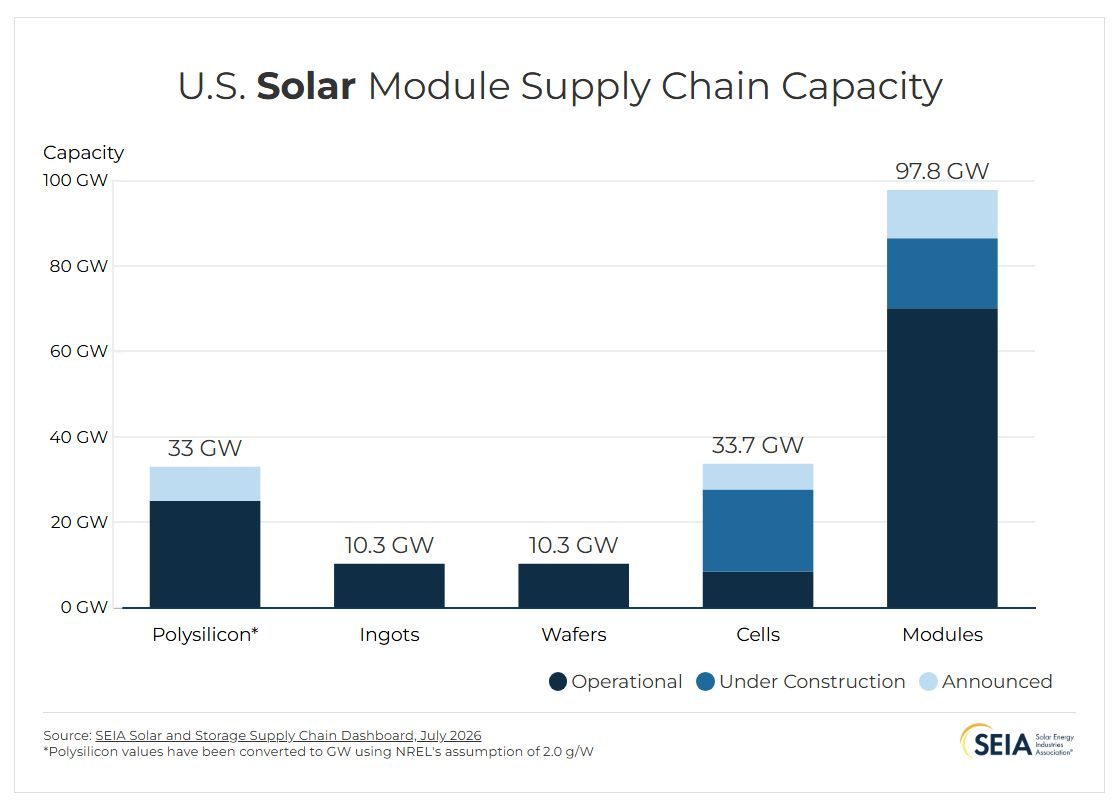
Against ~43 GW of annual installs, US racking is built out: 222 plants and Nextpower, Array Technologies, GameChange Energy & OMCO Solar all w/US lines. Modules look good too: 97.8 GW capacity, 70 GW running. But upstream falls short — polysilicon covers half of demand w/Hemlock Semiconductor in MI and WACKER in TN, ingots and wafers under a quarter, cells under a fifth.
US solar module supply chain capacity by stage. Source: SEIA Solar and Storage Supply Chain Dashboard, July 2026.
Cells are ramping: 19 GW under construction, roughly 3X today’s capacity. Ingots and wafers lag at 10.3 GW across 2 sites — Corning Incorporated in MI, Qcells North America in GA. Most new fabs will use imported wafers it seems.
A few module OEMs have full US product now. Qcells built the whole chain in GA, ingot to module. Heliene buys Suniva cells cut from Corning wafers. First Solar skipped Si cells from the start.
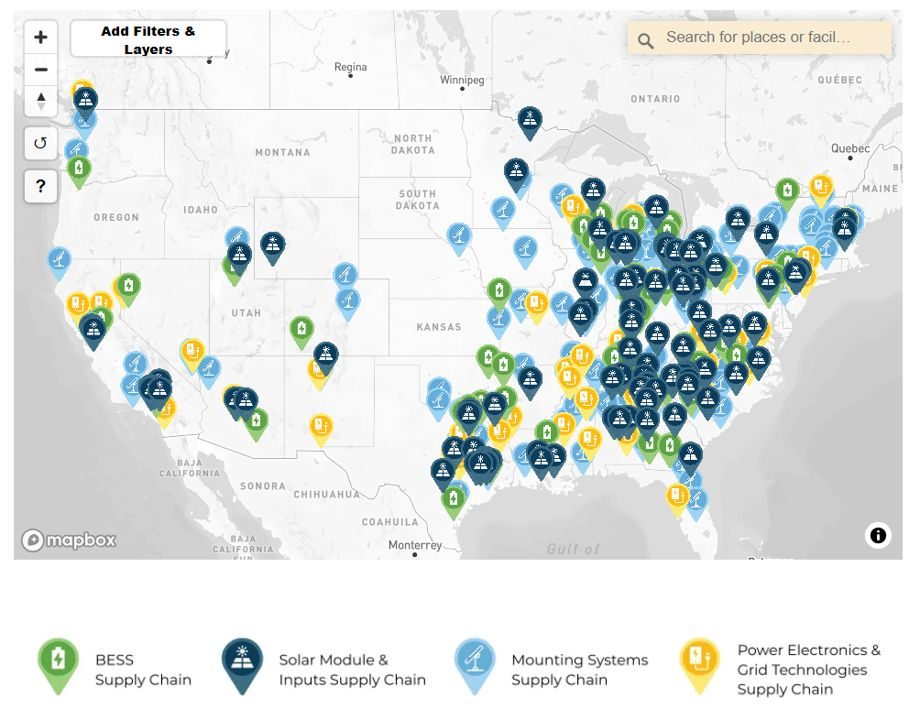
US solar and storage supply chain factories. Source: SEIA Solar and Storage Supply Chain Dashboard, July 2026.
SEIA’s map shows factories in old manufacturing towns of the Midwest, NE and SE. They’re growing because Chinese equipment carries risk US goods don’t: credit eligibility, border holds, tariffs. AD/CVD chases Chinese cells wherever assembly moves: India, Indonesia, Laos added recently. US sourcing avoids all three and lifts a 30% ITC to 40%.
The ITC adder starts with steel: 100% of structural steel and iron melted and poured in the US. You then calc cost shares using DOE’s safe harbor tables, since supplier data is hard to get. The bar is set when construction starts: 45% for 2025, 50% for 2026, 55% after. A fully domestic tracker counts 28.7%, leaving 21.3 points. Non-cell module parts total 23.1, but domestic glass is scarce. Cells settle it: 38.0 on foreign wafers, 51.6 on US wafers.
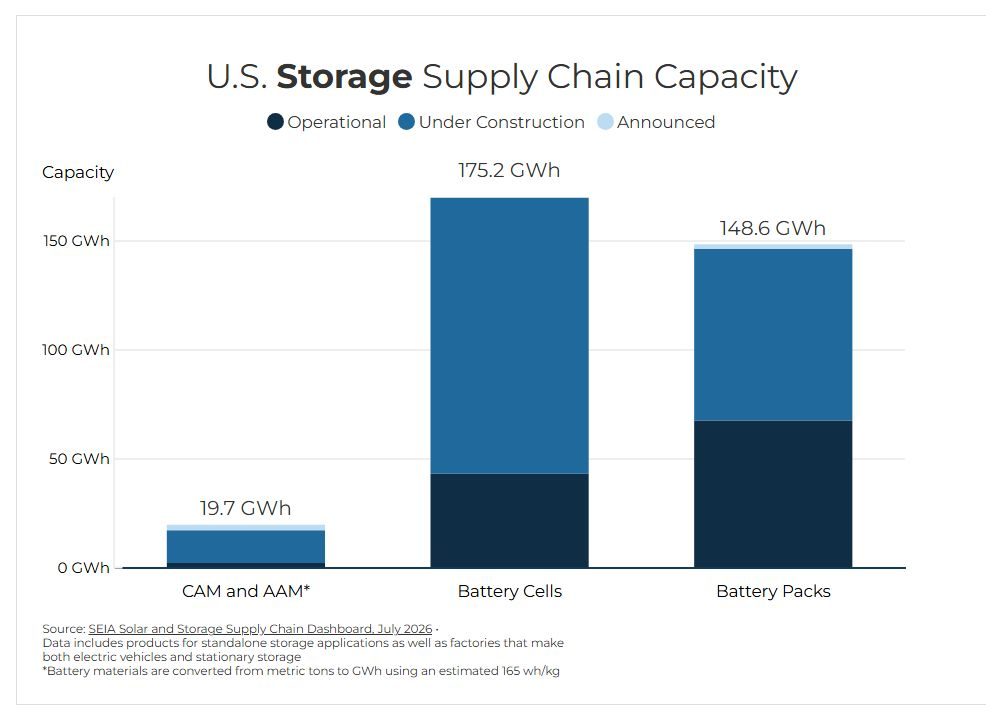
US storage supply chain capacity by stage. Source: SEIA Solar and Storage Supply Chain Dashboard, July 2026.
Storage clears more easily: US cells 52.0, packaging 5.6, container 14.8 — a US battery passes alone. Same supply paradox though: 67 GWh of US pack assembly against 51 GWh installed last year, 43 GWh of cells with 130 GWh announced, but only 19.7 GWh of cathode and anode materials.
FEOC — foreign entity of concern — runs a second calc on the same bill of materials. Domestic content asks where a part was made; FEOC asks who made it. A US plant with a Chinese parent is a prohibited entity, so its output counts for domestic content but not FEOC. Solar starting now needs 40% clear of such entities, storage 55%, rising to 60% & 75% by 2030.
True parity means US mining and processing. The minerals are here: quartz at Spruce Pine, NC, lithium at Silver Peak, NV, rare earths at Mountain Pass, CA. What’s thin is processing: silicon smelting, polysilicon purification, lithium refining, anodes/cathodes. Mountain Pass shipped rare earth concentrate to China until 2025, then built its own separation plant. That’s the model it seems.
Booking technical due diligence online, ahead of the OBBBA M&A wave
Similar to scheduling an appointment with a barber or hair stylist, you can now schedule, pay for, and kick off solar technical due diligence entirely online in minutes. I think that’s a first.
Book an appointment, show up, get the work done. Not how technical due diligence has usually been sold.
At NED, we’re offering two complementary services built for the M&A wave that the 7/4 beginning of construction deadline is about to unleash: a First Look Review with results in a day, and a Red Flag Review with a memo and Q&A log within a week. Both include one-on-one time with the engineer doing the work (me, until we need more people like me).
The 4th of July 2026 carries two meanings for solar: a 250th birthday, and the OBBBA beginning-of-construction deadline.
Why now? This 4th of July is bittersweet. Sweet in that we celebrate the 250th birthday of the longest-running continuous democracy in the world. Bitter in that it marks the White House’s OBBBA beginning-of-construction deadline for solar. But I’m a consummate optimist. At least now we’ll have a better read on which projects met the deadline and which didn’t — and can act accordingly.
Projects that met the criteria have until the end of 2030 to go online — typically very feasible. Projects that didn’t have to be placed in service by the end of 2027 — also feasible with a good interconnection queue position and construction plan, but obviously much harder. With so many Chinese components, #FEOC equipment risk is another major concern.
Analysts believe 7/4 will kick off a major bump in the volume and pace of M&A deals for solar. Development shops will sell de-risked projects at a premium, owner/operators will rebalance portfolios to match funding capacity, and FEOC-exposed projects will be sold to buyers who can remediate them with FEOC-free equipment. All of these deals will need a technical read before people commit to exclusivity — clearly for OBBBA and FEOC, but also for all the other important risks that make or break projects both short and long-term. That’s exactly what these services are built for.
The fast turnaround is possible through a novel #AI-human combo approach my co-founder Nolan Erck and I developed. The NED process does the heavy lifting using AI but also keeps the human in the loop. It ingests data rooms, runs due diligence checks (customized as needed), does error checking, but critically, it also requires the collaboration and confirmation of the expert overseeing the process. This reduces diligence time by up to 80% and frees up the engineer to do high value work — assessing risk materiality, developing risk mitigation strategies, supporting negotiation.
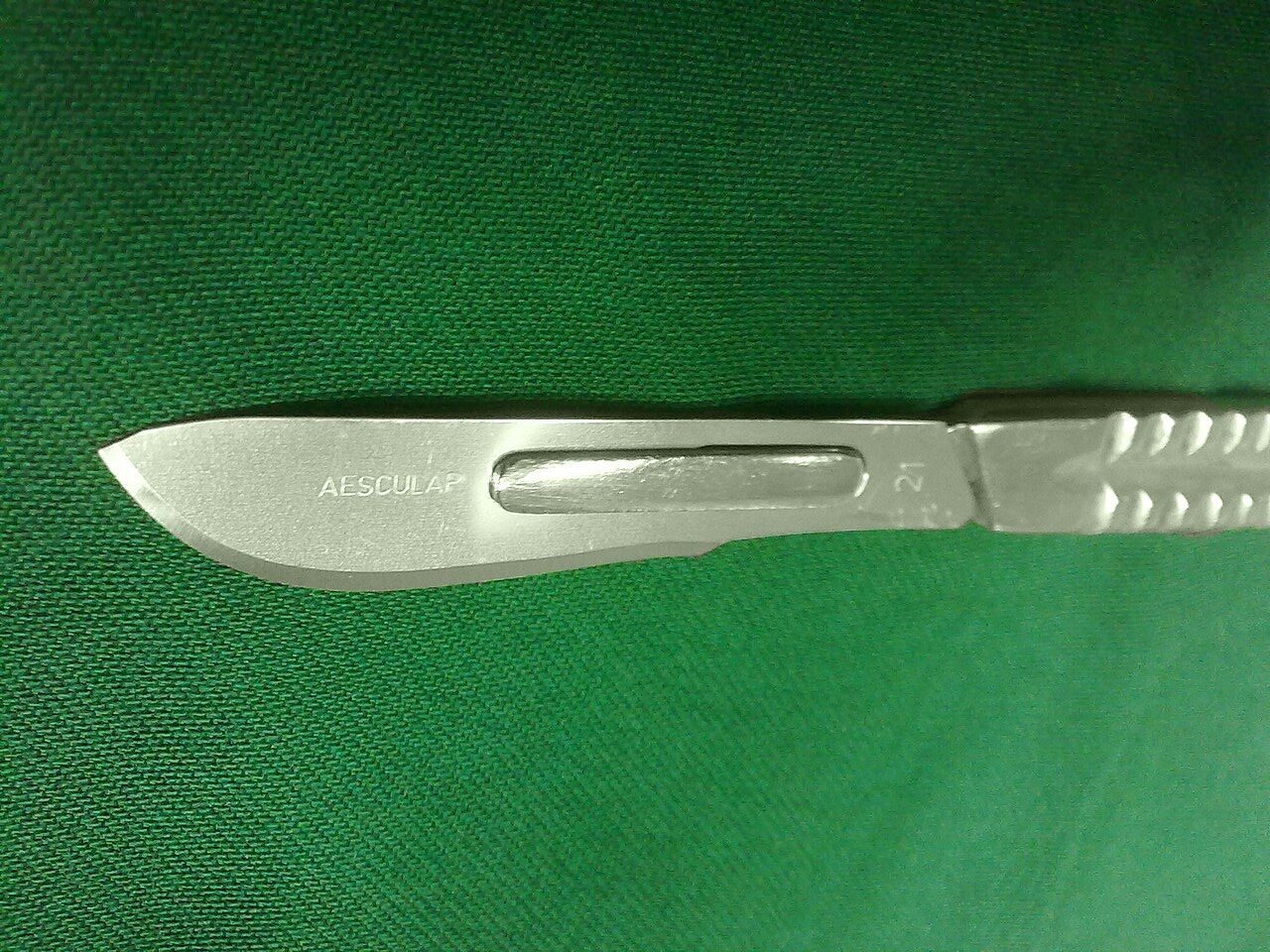
Powerful instruments, both. Neither is safe in untrained hands — which is the argument for keeping an expert inside an AI process.
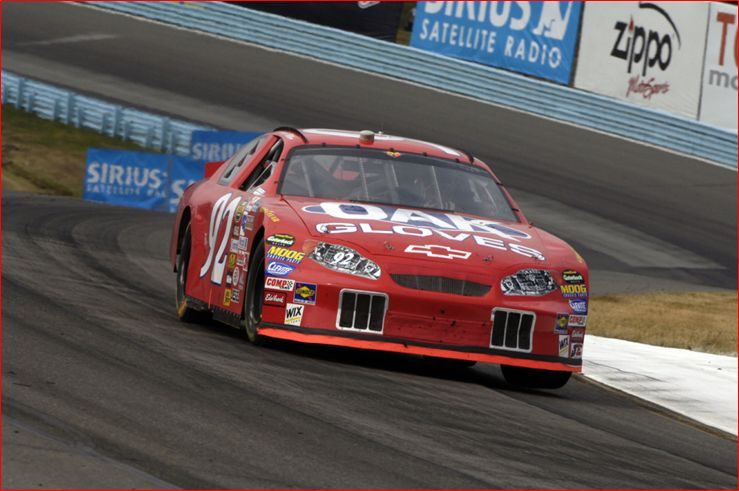
A racecar needs a professional driver; a scalpel should really only be used by a surgeon. High precision due diligence is not possible at the speed AI enables without a human deeply embedded in the process.
PV ModuleTech Napa: StormPlate, module quality, and the case for factory audits
Happy to have toasted the sun this past week with Jo McGraw, Lauren Cook, Natalie Batman and Chris Needham surrounded by vineyards at Sunrise Ranch Winery as part of #PVModuleTech in Napa. There are too many highlights to fit here, but here are a few.
Toasting the sun at Sunrise Ranch Winery during PV ModuleTech USA, Napa.
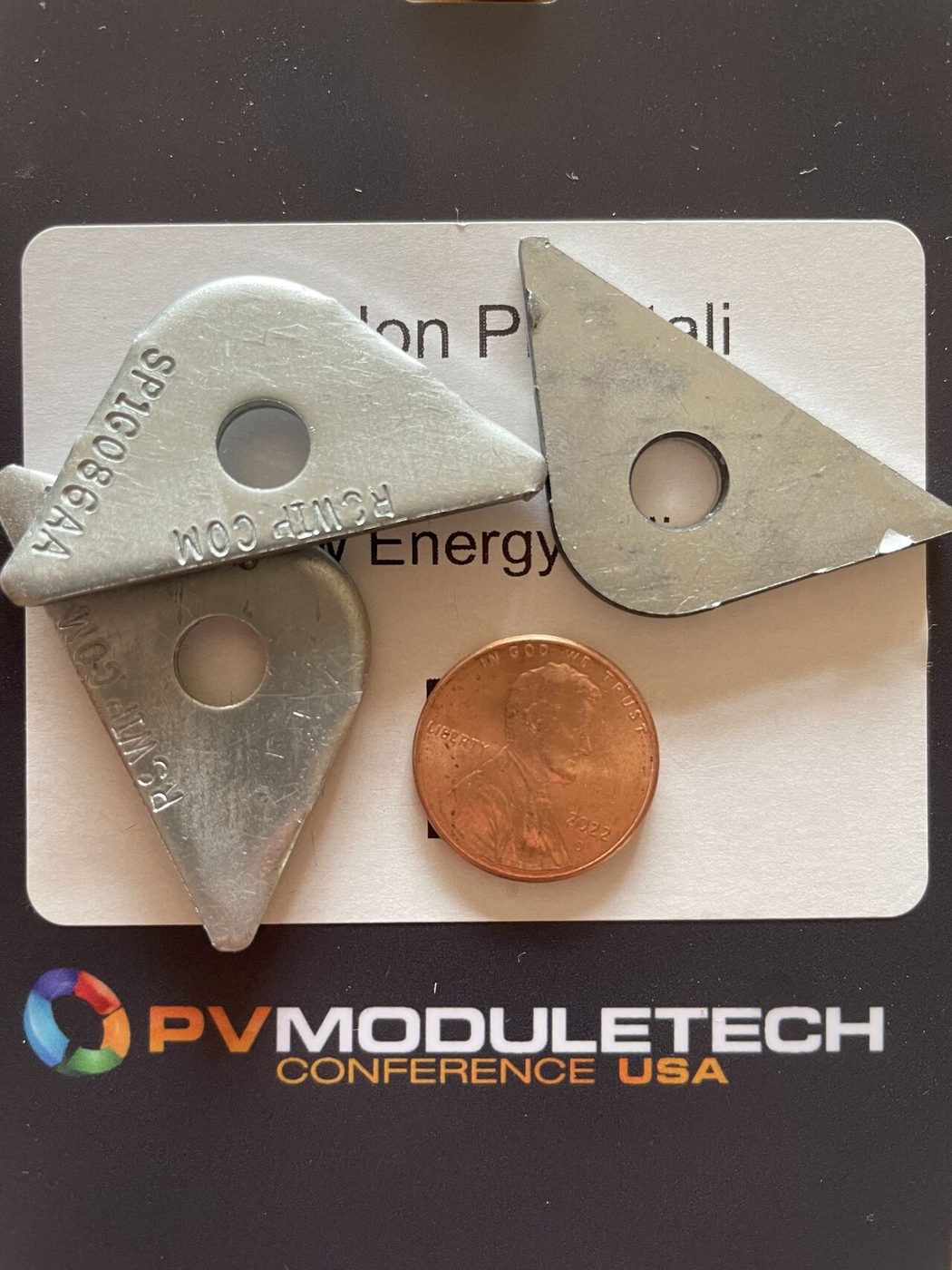
Excited to see adoption of the StormPlate (pictured) from my old friends Frank Oudheusden and Chris Needham at Resilient SolarWorks. PV modules pulled off trackers in high winds is a pernicious problem that this small, patented washer solves by increasing the strength of connections significantly and preventing pull-out failure. It also reduces the need for as many long rails.
The StormPlate, shown with a penny for scale. A patented washer that resists module pull-out failure in high winds.
Awesome to see such a huge ramp of domestic manufacturing and FEOC-free imports, but sad to see what I’d say is a continued decline in quality as demonstrated by Tristan Erion-Lorico in Kiwa PVEL test results.
On the flip side, great to hear from Ken Elser at Wells Fargo that their portfolio continues to be largely free of PV module defects due to the rigorous combination of factory audits and extended accelerated lifetime testing that people like Ian Gregory, Joe Duncan and Jenya Meydbray helped me put in place during my time at the bank.
Wonderful to be part of a convo between Chris Gabel and Glenn Davis from Kiwa PI Berlin and Teresa Barnes at National Laboratory of the Rockies (the lab formerly known as NREL) ideating about a new project that would prove the case for that level of QA and QC by comparing modules w/ and w/o it and performance stats from NLR’s (NREL’s) PV Fleet Performance Data Initiative.
Interesting to see Bram Hoex work on TOPCon cell issues. I think we need cell-fab-level audits and cell testing before they’re made into modules.
Also great to hear talks from friends Paul Wormser, Rebecca Alberti and April M. Jeffries, PhD on the complexities of BESS due diligence and procurement from cell to system. I agree we should apply factory audits and accelerated lifetime testing to BESS cells and units, too.
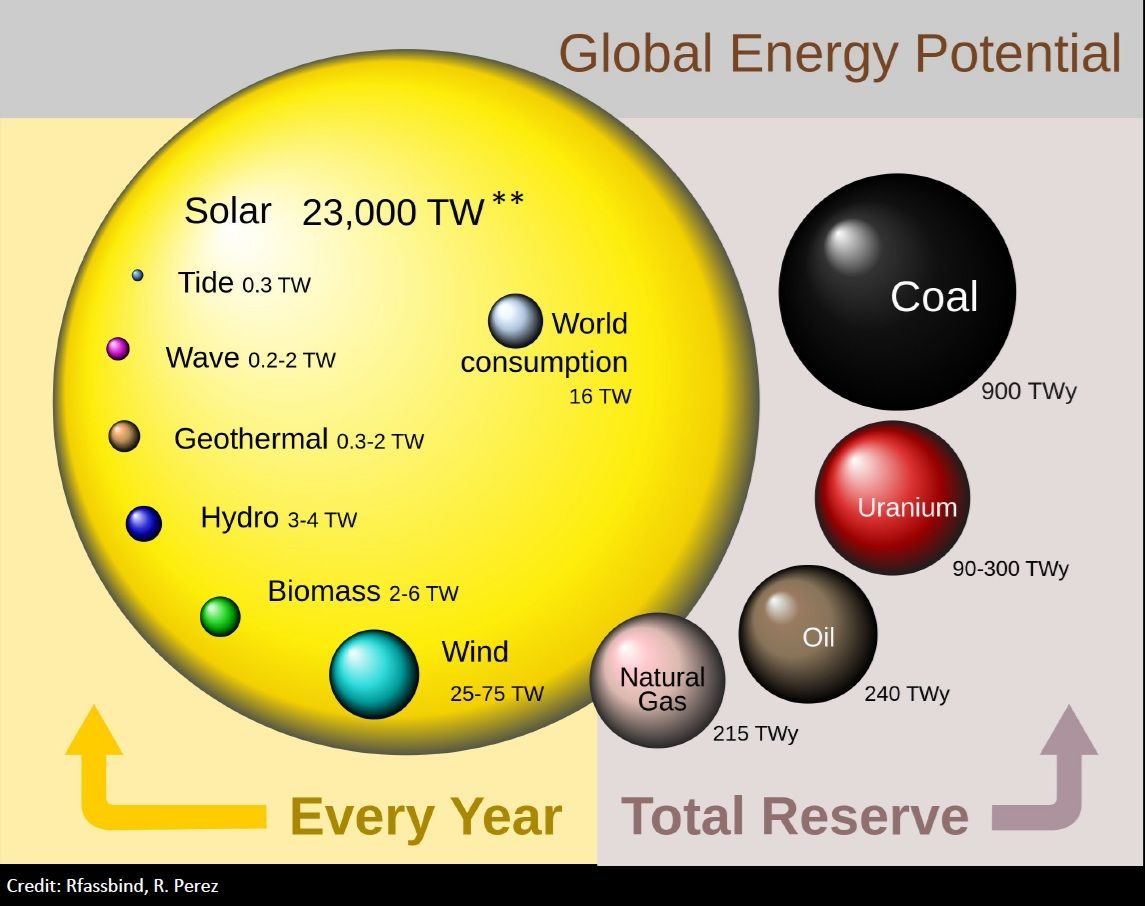
Annual renewable potential against total fossil and nuclear reserves, with world consumption at 16 TW. Credit: Rfassbind, R. Perez.
It’s offered through University of California, Merced Professional and Continuing Education (PACE) — UC Merced’s workforce and professional development arm, which partners with industry and faculty to deliver practical, career-focused training. It’s open to anyone (no application or affiliation needed) and costs $240, with $170 per student going to the university.
You don’t need an engineering background. The course is an approachable overview — with small deep dives into the science and technology — that follows the path of a single photon from the Sun all the way to the grid (thanks to Bill Reaugh for the idea), an homage to Einstein’s famous thought experiment of riding alongside a beam of light. Along the way you’ll learn about the history of solar and how solar power and battery energy storage systems (BESS) work: PV modules, inverters, transformers, Li-ion batteries, the grid, plus solar policy and financing. At the end, we’ll do a team project — a techno-economic model of a PV-BESS power plant using National Laboratory of the Rockies’s System Advisor Model (SAM). Whether you’re brand new to solar, looking to get into the field, are already working in solar but want to improve your tech literacy, or just curious to learn, this is a fun, casual way to learn about solar.
Also, a big congratulations to everyone who completed the two earlier sessions of the class this year — and those who finished the associated Riipen work-based learning project through UC Merced’s SkillRise program. We had a great crew of bright and dedicated students who learned how to be essential humans in the loop using Anthropic’s Claude AI to perform due diligence on PV module OEMs and products. That’s exactly the kind of job-ready skill that bridges the classroom and a solar career. Well done team!
NX Solar Insurer Forum 2026: hail stow, fire robotics, and telematics for underwriting
Great day last Wednesday at the NX Solar Insurer Forum 2026, hosted by Nextpower. The event brought four sides of the risk convo into one room — asset owners, insurance providers, advisors, and Nextpower, hardening solar power plants against nat cat perils like hail and fire.
Daniel Shugar opened with the macro case: solar is winning on LCOE and timelines (1 GW in roughly a year for ~$1B is hard to beat), and the only way growth stays bankable at scale is if risk gets engineered out, not just priced in (love that). Howard Wenger discussed the new Nextpower platform vision — a “Connected Power Plant” where trackers, foundations, software, power electronics (new) and robotics work together, with resilience designed in from day one (yes!).
With Ross Heiman at the NX Solar Insurer Forum — wearing the same uniform, as noted at the time.
It’s very heartening to hear how reliable hail stow is. Ross Heiman (wearing the same uniform as me btw) walked through the 2025 Texas hail season: 180+ hail stows across their Texas portfolio, ~1.1M modules protected, zero insurance claims. A truck parked on site… not as lucky. Across the broader Nextpower fleet, same pattern: forecast triggers stow, trackers rotate, projects walk away with no or minimal damage. 11 GW of Hail Pro 75° deployed, contracted, or under construction.
For fire risk mitigation, Derek Chase, who leads robotics at Nextpower, laid out the detection-and-prevention stack: NX Vantage scans for smoke & sends automated alerts to his team for verification who then notify ops staff to mobilize first responders in minutes. He also showed the NX Ranger robot doing under-panel optical and thermal scans, catching defective parts like cracked connectors before they cause fires.
New data sharing was another highlight. Jason Kaminsky, CEO, kWh Analytics, walked through a new telematics partnership with Nextpower — asset owners can now share real stow data with insurers, shifting underwriting from modeled assumptions to actual operational evidence. It mirrors how auto insurance uses driving data.
Greg Beardsworth led a great panel with the risk modeling and insurance consultant community — ReNew Risk, Moore-McNeil, VDE Americas and Moody’s — Insurance Solutions’s RMS — about translating physical risk into loss models to more accurately inform how property and business interruption insurance is priced. A lot of great insights.
Special thanks to other Nextpower friends who spoke Alex Roedel, Jyoti Jain, Andrew Griffiths, Martin Waters & all the great people who did the demos. And cheers to Jay Goldin, Greg Beardsworth, Gina Katz & the Nextpower marketing team for producing the event — you clearly put a lot of thought & effort into this. It showed.
Tandem PV opens its US perovskite demonstration facility in Fremont
It was great to be at Tandem PV’s ribbon cutting ceremony in Fremont yesterday as they officially opened their U.S. perovskite demonstration manufacturing facility. Tandem PV will use the new facility to optimize its manufacturing processes in preparation to scale production.
Tandem PV’s perovskite-silicon solar technology is up to 30% efficient, a threshold unattainable for conventional silicon PV alone. That higher power density means more energy from every acre of land on project sites that are almost always land constrained these days — and to paraphrase a potential buyer at the event, “our customers always want more power”. The new thin-film PV material also uses far less energy and material to make than standard crystalline silicon PV.
Thanks to the impressive lineup of speakers including Scott Wharton, CEO of Tandem PV; Colin Bailie, CTO and Co-Founder of Tandem PV; Jennifer Granholm, former U.S. Secretary of Energy; David Hochschild, Chair of the California Energy Commission; Daniel Shugar, CEO of Nextpower; and Raj Salwan, Mayor of City of Fremont. Your presence and words underscored how significant domestic PV module manufacturing is becoming — not just for the solar industry, but for the country as yet another way to reduce and hopefully someday break our dependence on the international fossil fuel market.
I’ll also mention as a member of the industry advisory board for the PACT (Photovoltaic Accelerator for Commercialization Technologies) center at Sandia National Laboratories since its founding in 2021, I’ve had a front-row seat to witness how far this technology has come. PACT is a DOE-funded independent validation effort led by Sandia and the National Laboratory of the Rockies (formerly NREL) that measures the performance and reliability of emerging perovskite PV technologies. It was great to hear about Tandem PV’s PACT test results yesterday and to see how the connection between PACT’s work and investor confidence has helped manifest Tandem’s new factory.
Huge thanks to Saritha Peruri, VP of Commercial Strategy, who MC’d and organized the event and all the Tandem PV team members who did a great job presenting each major step in the manufacturing process during the tours. Even in a torrential downpour, the house was packed and everything went off without a hitch.
Congratulations to the whole Tandem PV team on years of hard work leading to this significant milestone! Shine on!
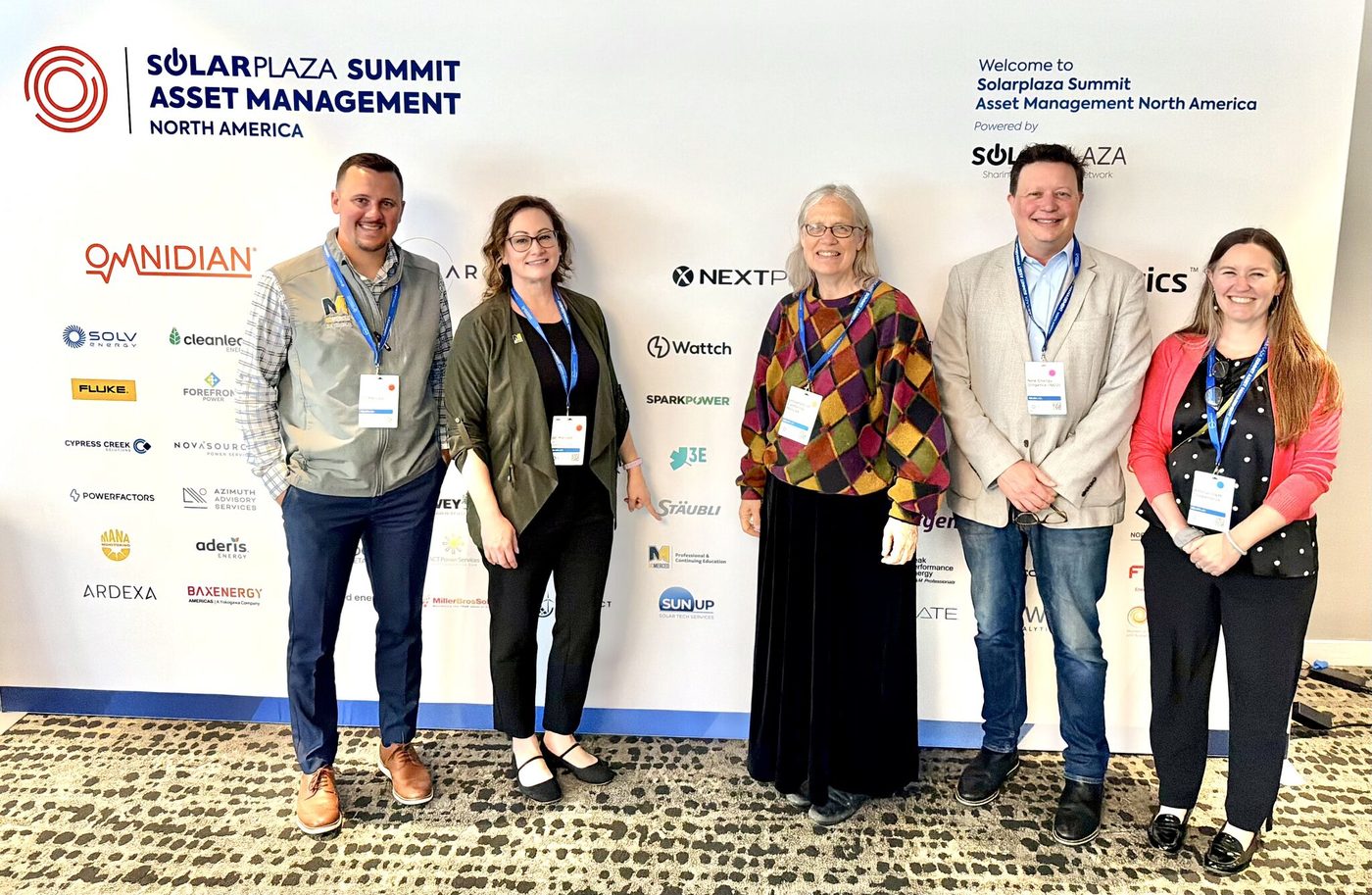
At Solarplaza Summit Asset Management North America, San Diego.
They’re in the early stages of developing a UC Merced Professional Certificate in Clean Energy Leadership: Solar Operations and Asset Management, and I’ve been glad to contribute to the draft curriculum. If you’re interested in teaching or participating, reach out to Annette or Michael directly.
I was also happy to catch up with my friend, and fellow advisor to the conference, Amanda Bybee with Amicus O&M Cooperative. Amanda and her team are doing incredible work supporting O&M and Asset Management professionals through their work cooperative, and O&M Training Programs.
Events like SAMNA are a good reminder of how much expertise and collaboration exists across this industry — and how much more we can accomplish together.
I’m happy to announce that I’m now working full time on my AI and human empowered consulting business, New Energy Diligence (NED). We’re taking on new clients.
At its core, NED provides technical due diligence services for renewable energy transactions — solar, storage, wind, fuel cells, and microgrids — covering the full lifecycle. This includes pre-exclusivity red flag reviews and deal team support for M&A, project finance, and tax credit transfers. It also includes support for post-funding technical obligations, fault analysis, warranty claims and other forms of remediation.
We are also offering services for special projects for renewable energy companies such as product design, software development and marketing. This includes helping organizations establish their own technical due diligence processes and advising on practical applications of AI to accelerate due diligence workflows.
I’ve been using AI for several years now and I’ve come to learn AI can’t replace people in work as complex as renewable energy transactions — they require human judgment, trust, and problem solving. AI is like a racecar or a scalpel — powerful tools that should be used by highly qualified experts. Due diligence still comes down to assessing the materiality of findings based on real-world experience, understanding what matters to each party, and negotiating solutions when issues arise. That requires people with experience across many transactions with a set of solutions that have worked before.
That said, due diligence is a real bottleneck to project finance, and AI significantly augments subject matter experts doing technical, legal, and commercial reviews.
We need AI — climate change is a greater risk than ever before, ironically in part because of AI itself. In the face of unbridled attacks on the renewable energy sector in the US and geopolitical violence in the name of fossil fuels, it’s never been clearer to me that we need to expedite the transition to clean energy and break our reliance on oil. I’m convinced that AI can help us out of this quagmire just as other groundbreaking technologies have helped humanity in the past.
It’s bittersweet leaving the great team at VDE Americas after three and a half years. I’m proud of what I helped accomplish there — commercializing hail risk services, expanding the customer base, launching a customer portal, and growing revenue and profitability to record levels. I’m also happy to say I get to continue working with two collaborators, software expert Nolan Erck who is my NED co-founder and CTO and marketing specialist (and my wife) Meghan Sheedy who will lead marketing projects at NED.
I’ll be attending Solarplaza Asset Management North America in San Diego next week and speaking as part of their Emerging Leaders Program — reach out if you want to meet there.